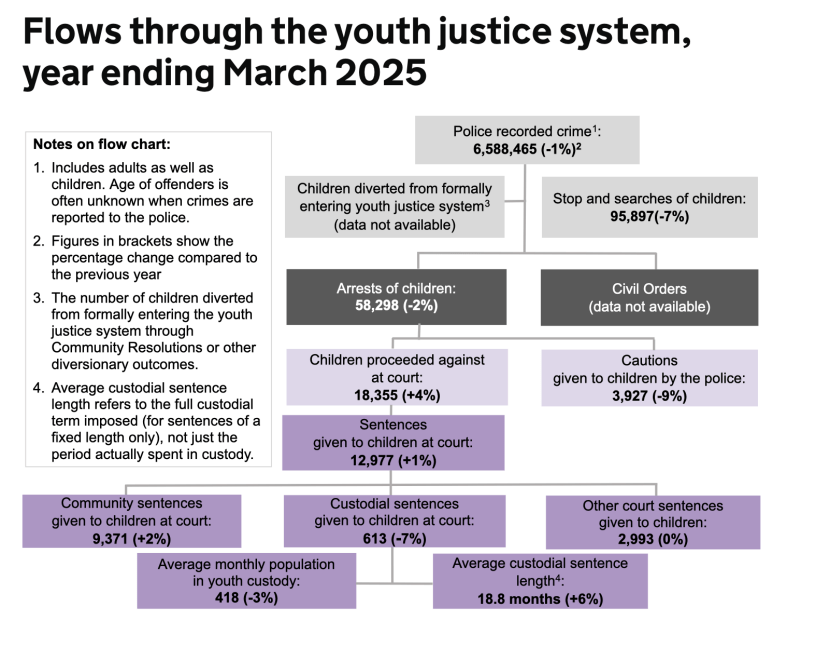
In recent years, youth crime has become an increasingly prominent social issue in the UK. Almost every week, we hear reports on social media or in the news of violent offences committed by British youths, such as knife robberies and gang-related activities. According to the latest youth justice statistics from the UK Ministry of Justice, as of March 2025, approximately 58,300 children aged 10–17 had been arrested for criminal offences in England and Wales. During the same period, 18,355 children were prosecuted in court, and 12,977 received formal sentences, comprising 9,371 community sentences and 613 custodial sentences. The average length of custodial sentences rose to 18.8 months, an increase of 6% compared to 2024. What a terrifying figure this is; the problems caused by youth crime remain a ‘cancer’ deeply rooted in the path to a safe upbringing for all young people.
What drives these young people down this ‘path of no return’ into crime? I believe the rise in youth crime in the UK is closely linked to poverty, education and racism. The state needs to address these structural injustices through social and policy reforms.
Firstly, poverty is one of the key factors contributing to youth crime in the UK. Nearly one in three (30%) children lived in poverty in the UK in 2022/23. (RCPCH, 2024)
Their household income was below 60% of the national median, which means that the majority of them are unable to receive a good education and are at risk of poorer health outcomes, including a higher risk of death, poor physical health and mental health issues; consequently, their crime rates are also high. To address this issue, the government should implement stronger anti-poverty policies to safeguard these children’s education and living conditions. For example, the government could increase the amounts of Child Benefit and Universal Credit, enabling more families living in poverty to secure a stable income and thereby reducing the rate of juvenile crime. The government could also establish free vocational training programmes to help school leavers, ex-offenders and children from disadvantaged backgrounds acquire vocational skills, thereby assisting them in finding employment and reducing their incentive to seek income through illegal means.
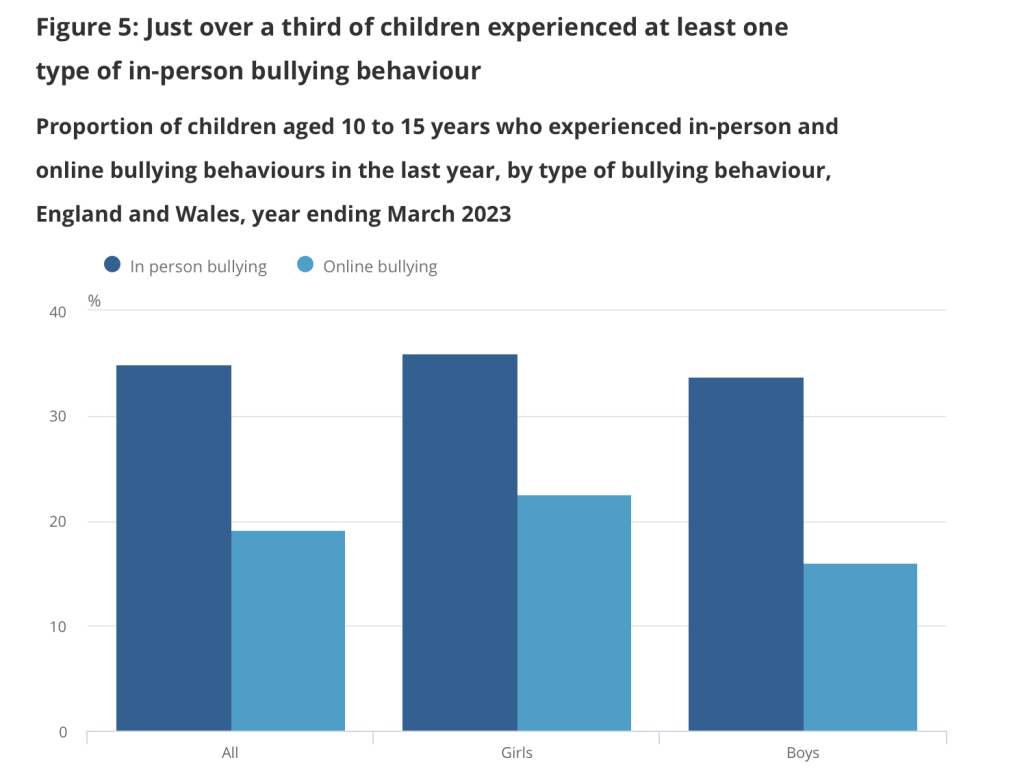
Secondly, in the context of education, school bullying is extremely common among young people in the UK. An estimated 1,544,000 children aged 10 to 15 (34.9%) experienced in-person bullying and 847,000 (19.1%) experienced online bullying in the year ending March 2023. (Office for National Statistics, 2023) This means that approximately 1.54 million children in the UK have experienced face-to-face bullying. When bullying becomes a widespread phenomenon, it not only affects pupils’ mental health but may also foster a culture of violence within schools, leading to more serious criminal behaviour. Although schools have taken measures such as expelling bullies to protect victims, ‘exiling’ these bullies has, in fact, created a breeding ground for the rise in youth crime. According to a 2025 study by The Guardian, within a year of being excluded from school, excluded children are more than twice as likely to commit serious violent crimes as their peers. “Excluded children typically become isolated and lose self-esteem, making them an easy target for gangs.” (Kate Aubrey-Johnson, 2025) After being expelled from school, these young people are more likely to turn to crime.I believe the government should require schools to deliver regular anti-bullying education programmes, establish anonymous reporting systems, and conduct more transparent investigations and reporting of serious bullying incidents. Than, for bullies whose behaviour is less severe, the government could encourage schools to adopt restorative justice approaches as an alternative to expulsion, enabling the perpetrators to take responsibility and understand the harm caused by their actions, whilst helping victims regain a sense of security.
Thirdly, racism is also a significant trigger for youth crime. In the UK, racial inequality is particularly evident within the youth justice system. Data shows that Black children account for approximately 22% of the population in UK youth prisons, yet their proportion of the national child population is far lower than this figure; this means they are several times more likely to enter the prison system than other groups. Racial discrimination is also evident in policing practices and judicial decisions. For example, a study analysing approximately 265,000 London police records (2015–2022) found that Black children were 15% more likely than White children to face formal charges or enter the judicial process following an arrest. I call on the government to increase economic and social investment in ethnic minority communities to create better educational and living environments for children. At the same time, more legitimate opportunities for development should be created for young people to reduce the likelihood of their involvement in criminal activities. The government also needs to strengthen oversight of law enforcement agencies; for instance, by increasing the number of positions held by Black people or members of other ethnic minorities, enhancing transparency in law enforcement, and establishing independent oversight mechanisms to minimise potential racial bias.
Ultimately, juvenile delinquency in the UK should be viewed as a reflection of social inequality rather than the result of individual choices. Addressing this issue requires structural solutions, such as reducing poverty, strengthening community support systems, expanding educational opportunities and reforming the judicial system. Only by tackling these fundamental issues can society reduce juvenile delinquency and provide young people with more equitable opportunities.
References:
1.Justice, Y. (2026). Youth Justice Statistics: 2024 to 2025. [online] GOV.UK. Available at: https://www.gov.uk/government/statistics/youth-justice-statistics-2024-to-2025/youth-justice-statistics-2024-to-2025?utm_source=chatgpt.com.
2.RCPCH. (2024). Child health inequalities driven by child poverty in the UK – position statement. [online] Available at: https://www.rcpch.ac.uk/resources/child-health-inequalities-position-statement?utm_source=chatgpt.com.
3.Office for National Statistics (2024). Bullying and Online Experiences among Children in England and Wales – Office for National Statistics. [online] Office for National Statistics. Available at: https://www.ons.gov.uk/peoplepopulationandcommunity/crimeandjustice/bulletins/bullyingandonlineexperiencesamongchildreninenglandandwales/yearendingmarch2023.
4.Fazackerley, A. (2025). Teenagers excluded from school ‘twice as likely’ to commit serious violence. [online] the Guardian. Available at: https://www.theguardian.com/education/2025/mar/22/teenagers-excluded-from-school-twice-as-likely-to-commit-serious-violence?utm_source=chatgpt.com.
5.Restorative Justice Council (2016). What is restorative justice? | Restorative Justice Council. [online] Restorativejustice.org.uk. Available at: https://restorativejustice.org.uk/what-restorative-justice.
6.Youthendowmentfund.org.uk. (2026). Welcome To Zscaler Directory Authentication. [online] Available at: https://youthendowmentfund.org.uk/reports/core-indicators-of-violence/disproportionality/.
7.Dodd, V. (2025). Black children arrested in London ‘15% more likely to be criminalised’ than white children. [online] the Guardian. Available at: https://www.theguardian.com/uk-news/2025/jun/27/black-children-arrested-london-more-likely-criminalised-than-white-children.
 Site Title
留下评论