Shiyu Yang
Note: when this post discusses the “UK”, it relies mainly on public statistics from England and from England and Wales, because youth justice, education and youth services are devolved policy areas and the official datasets are not always fully aligned across the UK.
| If a society only notices children after something has already gone wrong, it is dealing not with the roots of the problem, but only with its consequences. |
Introduction: Why “solving youth crime” cannot simply mean “getting tougher”
When people talk about youth crime in the UK, it is very easy to slip into a simple story: there are more “bad kids” than before, so the answer must be more police and harsher punishment. Recent official statistics do not support that one-dimensional view. In the year ending December 2024, the number of first time entrants to the youth justice system in England and Wales fell to just over 8,100, the lowest figure in the series (Youth Justice Board, 2026). At the same time, exclusion from school has moved in the opposite direction: in England there were 955,000 suspensions and 10,900 permanent exclusions in the 2023/24 academic year, both higher than in the previous year (Department for Education, 2025). Looking at the wider social picture, 2.72 million children aged 0–15 were still living in relative low-income families in the financial year ending 2024 (Department for Work and Pensions, 2025).
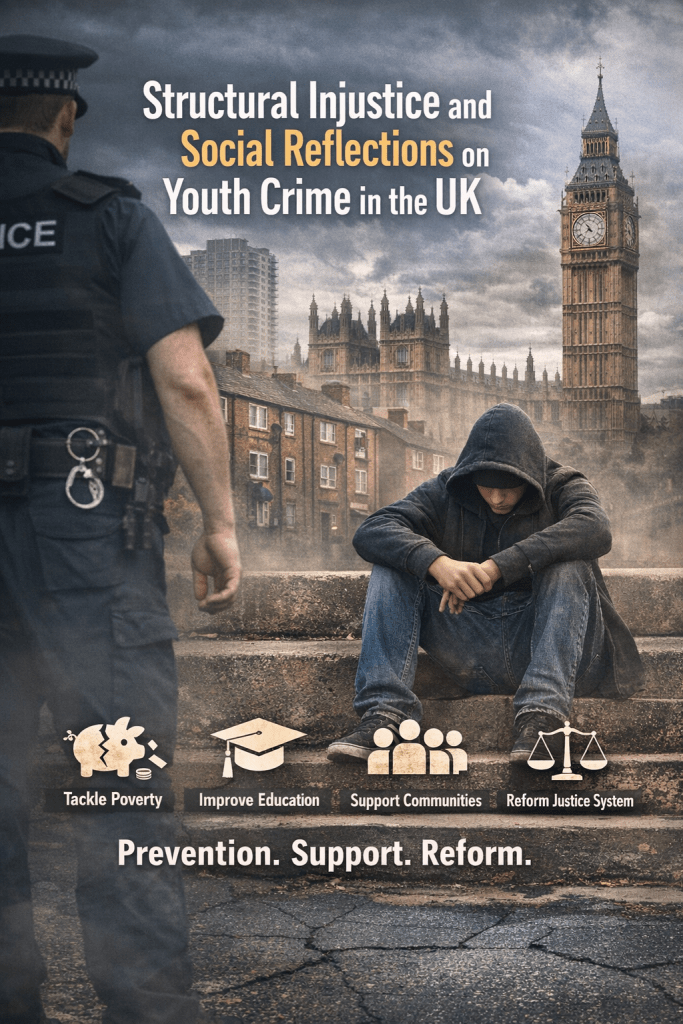
Taken together, these figures point to something important. A fall in the overall number of children entering the youth justice system does not mean that risk has disappeared. If anything, it suggests that the more urgent question is not simply “why do some children offend?”, but “why are some children much more likely to grow up in environments marked by exclusion, neglect and persistent exposure to risk?” If the broader theme of this blog is structural injustice and social reflection, then this section should focus less on how the justice system reacts after harm has happened, and more on how social policy can reduce the conditions that push children towards offending in the first place.
1. Effective responses have to begin with structural risk, not just individual blame
Research consistently shows that youth involvement in crime or violence is rarely the product of a single personal choice. In a review of systematic reviews, Ullman et al. (2024) identify stable protective factors such as positive family relationships, educational engagement and access to employment opportunities. By contrast, long-term unmet needs, weak attachment to school and a lack of opportunity all increase risk. The Youth Endowment Fund’s evidence review makes a similar point: poverty should not be reduced to a single direct cause of offending, but it is clearly associated with a higher risk of youth crime and violence, especially when low income, financial stress, neighbourhood deprivation and other adverse experiences accumulate together (Youth Endowment Fund, 2025b).
That matters because tackling youth crime is not, at heart, a matter of asking the criminal justice system to pick up the pieces. It requires reconnecting anti-poverty policy, educational support, youth services, mental health provision, community safety and diversion pathways. In other words, good policy does not start by labelling children as dangerous. It starts earlier, by pulling them away from the conditions that make danger more likely.
2. If youth crime is to fall in a meaningful way, at least five social and policy responses need to move together
1) Treat anti-poverty policy as part of crime prevention
Public debate often separates “law and order” from “welfare”, as if one belongs to the street and the other only to the home. For young people, however, the two are deeply connected. Persistent poverty shapes how families cope with pressure, and it narrows children’s access to stable housing, adequate food, transport, extracurricular activities and trusted adult support. Using data from the UK Millennium Cohort Study, Adjei et al. (2025) show that persistent poverty, especially when combined with family adversity, significantly increases the likelihood of weapon-related behaviour and police contact in adolescence. The UK government’s recent child poverty strategy also places family income, living costs and stronger local support services at the centre of its response (Cabinet Office, 2025).
For that reason, reducing youth crime cannot be discussed as though poverty were a distant or secondary background issue. A stronger long-term response would bring income support, housing stability, debt relief, school meals, transport access and early family support into the same prevention framework. This is not because poverty mechanically “causes” crime, but because families under constant material pressure are far less able to provide the security, routine and sense of future that children need.
2) Keep children in school and treat inclusion as frontline prevention
School is not simply a place of instruction. For many children, it is the most stable and universal form of everyday public support they have. Once a child is repeatedly absent, frequently suspended or eventually excluded from mainstream education, their connection to trusted adults, peers and daily structure often weakens all at once. Cornish and Brennan’s (2025) target trial emulation study finds a worrying association between school exclusion and later serious violence. Jay et al. (2023) also show that children with social care involvement or special educational needs face a substantially higher risk of exclusion than their peers. The present trend is therefore alarming: permanent exclusions in England rose to 10,900 in the 2023/24 academic year (Department for Education, 2025).
Educational policy should therefore do more than preserve discipline. It should move towards genuinely inclusive school governance. Earlier identification of SEND and mental health needs, less reliance on suspension as a way of outsourcing complex difficulties, higher-quality alternative provision, and stronger attendance support before problems escalate would all matter here. For children at higher risk, school is not a side issue. It is one of the central sites of prevention.
3) Rebuild community youth services instead of relying on policing after crisis
If schools are the key support setting during the day, then youth services often become the second protective net after school and at weekends. The difficulty is that this net has been seriously weakened over the last decade. Using a quasi-natural experiment on youth club closures in London, Villa (2024) finds that closures increased the probability of youth offending among 10–17-year-olds by 14 per cent in affected areas, while educational outcomes also worsened. This suggests that youth services are not optional extras. They can directly shape offending risk, educational performance and social belonging.
A more credible policy response, then, is not a short-lived pilot but stable and sustained investment in youth provision: reopening community youth centres, prioritising disadvantaged areas, and treating youth workers as a permanent part of local infrastructure rather than temporary project staff. This thinking is reflected in the UK’s recent Youth Matters strategy, which places access to support, trusted adults and safe spaces back at the centre of youth policy (HM Government, 2025). The contradiction to avoid is obvious: a society cannot hollow out community support and then expect policing alone to absorb the consequences.
4) Make diversion and child-first youth justice the default, not the exception
For children who have already come into contact with the police or justice system, the key policy question is not simply whether the process is efficient. It is whether formal system contact can be kept to a minimum. Recent evidence is fairly clear on this point: earlier and more front-end diversion tends, on average, to reduce reoffending, reduce violence and lower the later seriousness of offending; the strongest effects are often found in pre-charge diversion and among younger children (Ely and Hardy, 2025). This direction is also consistent with the continued fall in first time entrants to the youth justice system in England and Wales (Youth Justice Board, 2026).
The problem, however, is that good principles do not guarantee good implementation. A 2025 joint inspection report found major regional differences in diversion thresholds, available resources and service coordination, creating what is effectively a postcode lottery. Many children still complete diversion processes without their educational, mental health or family needs being properly addressed (HM Inspectorate of Probation and HM Inspectorate of Constabulary and Fire & Rescue Services, 2025). So the better path is not simply to talk more about “light-touch” responses, but to build a clearer national framework, more transparent decision-making, fewer child detentions in police custody, and faster access to education, health and family support.
5) Use a public health approach for local coordination instead of leaving agencies to work in silos
The Serious Violence Duty introduced in recent years already reflects an important recognition in England and Wales: violence and youth offending cannot be reduced by one sector acting alone. The statutory guidance requires local authorities, police, health services, education providers and youth justice bodies to identify local drivers of violence, share data, develop strategies and focus on prevention and early intervention over the long term (HM Government, 2022). The value of this approach lies not only in the language of “partnership”, but in its shift from reacting to incidents towards governing risk: asking which groups are most vulnerable, which neighbourhoods are consistently under-resourced, and where the gaps between services remain.
Two further points are crucial if this public health model is to mean more than administrative coordination. First, the lived experience of young people and communities has to shape decision-making; professionals cannot simply meet with one another and assume that is enough. Second, inequalities linked to racialisation, SEND, care experience and neighbourhood poverty need to be mapped together rather than treated separately. Otherwise, “joined-up working” risks becoming procedural cooperation without any real structural repair.
3. A wider social reflection: do we want to control children, or make sure they still have routes forward?
Perhaps the most difficult question here is not whether punishment is severe enough, but when society chooses to notice young people in the first place. Too often, children become visible to public systems only after they have been suspended, stopped by police or labelled by the media. Long before that point, many will already have lived through poverty, family strain, failed identification of additional needs, the withdrawal of community support, long waits for mental health care and increasing educational marginalisation.
A mature social response, then, would treat youth crime not only as an issue of order, but as a stress test of institutional quality. Whether an area succeeds in reducing youth offending depends not just on policing capacity, but on whether children have stable housing, trusted adults, schools they can stay in, youth services they can actually use, and developmental pathways that do not criminalise them too early. In the end, the most effective crime policy may not begin in the courtroom at all. It may begin at the school gate, in the community centre, in family support services and in the priorities written into local budgets.
References
Adjei, N.K., Jonsson, K.R., Opoku-Ware, J., Yaya, S., Chen, Y., Bennett, D., McGovern, R., Munford, L., Black, M. and Taylor-Robinson, D. (2025) ‘Impact of family childhood adversity on risk of violence and involvement with police in adolescence: findings from the UK Millennium Cohort Study’, Journal of Epidemiology and Community Health, 79(6), pp. 459–465. Available at: https://doi.org/10.1136/jech-2024-223168.
Cabinet Office (2025) Our Children, Our Future: Tackling Child Poverty. London: Cabinet Office. Available at: https://www.gov.uk/government/publications/our-children-our-future-tackling-child-poverty.
Cornish, R.P. and Brennan, I. (2025) ‘Exclusion from School and Risk of Serious Violence: A Target Trial Emulation Study’, British Journal of Criminology, 65(6), pp. 1221–1240. Available at: https://doi.org/10.1093/bjc/azaf015.
Department for Education (2025) Suspensions and Permanent Exclusions in England, Academic Year 2023/24. London: Department for Education. Available at: https://explore-education-statistics.service.gov.uk/find-statistics/suspensions-and-permanent-exclusions-in-england/2023-24.
Department for Work and Pensions (2025) Children in Low Income Families: Local Area Statistics, Financial Year Ending 2024. London: Department for Work and Pensions. Available at: https://www.gov.uk/government/statistics/children-in-low-income-families-local-area-statistics-2014-to-2024/children-in-low-income-families-local-area-statistics-financial-year-ending-2024.
Ely, C. and Hardy, S.-J. (2025) Diversion Practice Guidance: Guidance on How to Deliver Diversion Effectively for Children and Young People. London: Centre for Justice Innovation and Youth Endowment Fund. Available at: https://justiceinnovation.org/sites/default/files/media/document/2025/diversion_practice_guidance.pdf.
HM Government (2022) Serious Violence Duty: Preventing and Reducing Serious Violence – Statutory Guidance for Responsible Authorities, England and Wales. London: Home Office. Available at: https://assets.publishing.service.gov.uk/media/639b2ec3e90e072186e1803c/Final_Serious_Violence_Duty_Statutory_Guidance_-_December_2022.pdf.
HM Government (2025) Youth Matters: Your National Youth Strategy. London: HM Government. Available at: https://www.gov.uk/government/publications/youth-matters-your-national-youth-strategy/youth-matters-your-national-youth-strategy.
HM Inspectorate of Probation and HM Inspectorate of Constabulary and Fire & Rescue Services (2025) The Effectiveness of Diverting Children from the Criminal Justice System: Meeting Needs, Ensuring Safety, and Preventing Reoffending. Available at: https://hmiprobation.justiceinspectorates.gov.uk/document/the-effectiveness-of-diverting-children-from-the-criminal-justice-system-meeting-needs-ensuring-safety-and-preventing-reoffending/.
Jay, M.A., Mc Grath-Lone, L., De Stavola, B. and Gilbert, R. (2023) ‘Risk of school exclusion among adolescents receiving social care or special educational needs services: a whole-population administrative data cohort study’, Child Abuse & Neglect, 144, 106325. Available at: https://doi.org/10.1016/j.chiabu.2023.106325.
Ullman, R., Lereya, S.T., Glendinnin, F., Deighton, J., Labno, A., Liverpool, S. and Edbrooke-Childs, J. (2024) ‘Constructs associated with youth crime and violence amongst 6–18 year olds: a systematic review of systematic reviews’, Aggression and Violent Behavior, 75, 101906. Available at: https://doi.org/10.1016/j.avb.2023.101906.
Villa, C. (2024) The Effects of Youth Clubs on Education and Crime. IFS Working Paper W24/51. London: Institute for Fiscal Studies. Available at: https://ifs.org.uk/publications/effects-youth-clubs-on-education-and-crime.
Youth Endowment Fund (2025b) Evidence Review on Poverty and Youth Crime and Violence. London: Youth Endowment Fund. Available at: https://youthendowmentfund.org.uk/wp-content/uploads/2025/08/YEF-Poverty-Evidence-Review-Technical-Report-August-2025.pdf.
Youth Justice Board (2026) Youth Justice Statistics: 2024 to 2025. London: Youth Justice Board. Available at: https://www.gov.uk/government/statistics/youth-justice-statistics-2024-to-2025/youth-justice-statistics-2024-to-2025.
 Site Title
留下评论