Zimeng Yin
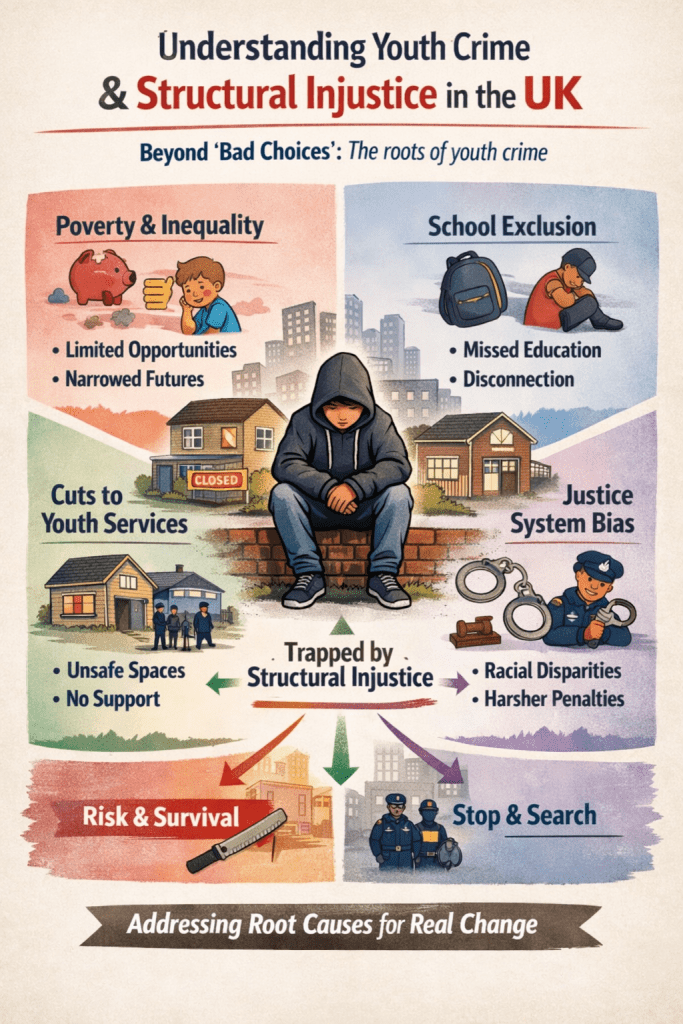
When youth crime makes the headlines in the UK, the public conversation often turns into a quick moral judgement: “What’s wrong with young people today?” But that framing misses a bigger question: why are some young people much more exposed to the conditions that make crime feel normal, necessary, or even protective? If we only talk about “bad choices,” we ignore the structural injustice that shapes which choices are available in the first place.[1]
This blog focuses on one angle: what structural injustice looks like in everyday UK life, and why it matters for understanding youth crime. The point is not to excuse harm, but to explain why the same “anti-crime” messages often fail when young people live in environments where risk is built into the system.
1) Poverty is not only about money—it’s about narrowed futures
Poverty does not automatically cause youth crime. But it raises the likelihood of being exposed to risk factors: instability at home, stress, fewer safe spaces, fewer opportunities, and fewer adults with time and capacity to support young people. The Youth Endowment Fund’s evidence review highlights that poverty is associated with increased risk of youth crime and violence,[2] even if it does not argue for a simple “poverty causes crime” relationship (Youth Endowment Fund, 2025a).
In the UK, poverty—especially child poverty—remains a major social issue. The Joseph Rowntree Foundation regularly reports that large numbers of children live in poverty, and hardship is not evenly distributed across society[3] (Joseph Rowntree Foundation, 2026). When families struggle with rent, food, debt, and insecure work, teenagers often absorb the pressure. That pressure can translate into mental health strain, missing school, and vulnerability to groups that promise income or protection.
Structural injustice here is not just the existence of poverty—it is the way poverty clusters geographically, limiting access to opportunity. If you grow up in an area with fewer youth services, weaker transport, and under-resourced schools, “making the right choices” becomes a different challenge.
2) Education inequality and exclusion can push young people out of the mainstream
Schools do more than teach; they shape belonging and future pathways. When education systems are under strain, the first supports that often weaken are those that help vulnerable students: pastoral care, mental health support, SEND-informed provision, and stable mentoring.
Department for Education statistics show high levels of suspensions and permanent exclusions in England[4] (Department for Education, 2025). This matters because exclusion often connects to wider unmet needs, family instability, and mental health challenges. When a young person is repeatedly suspended or excluded, they lose routine, supervision, and access to protective institutions.
Evidence also suggests that school absence, suspension, and exclusion can be linked with later risks, including violence-related outcomes[5] (Rollings, 2025). Schools must keep students safe, but structurally we should ask: why are exclusions rising, and why do some communities experience them more intensely? If the response becomes mainly punitive, young people can be pushed further from mainstream support.
3) Cuts to youth services leave a gap that policing cannot fill
Youth clubs, youth workers, and community spaces are not “extras.” They provide trusted adults, belonging, supervision, and alternatives to street-based social life. Research from the Institute for Fiscal Studies finds that youth club closures in London were associated with worse educational outcomes and an increased likelihood of teen crime[6] (Institute for Fiscal Studies, 2024).
This is structural injustice in action: when youth services disappear, young people do not disappear—they spend more time in unmanaged spaces. In some contexts, the “community” that remains accessible is offered by exploitative networks, gangs, or violent peer groups.
4) Violence risk is uneven—and young people feel it
Youth violence is not only a crime issue; it is a safeguarding and public health issue. The Youth Endowment Fund’s work on violence and vulnerability[7] shows that young people’s exposure to violence and risk can be widespread and deeply shaped by where they live and what support exists around them (Youth Endowment Fund, 2024).
When young people feel unsafe, carrying a weapon can be framed as “self-protection,” even though it increases risk for everyone. This mindset is shaped by environment: peer norms, trust in institutions, and whether there are safe routes and safe spaces.
National trends also matter. Official statistics track knife crime and wider violence patterns, but structural injustice is often about uneven distribution across places and groups[8][9] (Office for National Statistics, 2026; UK Parliament, House of Commons Library, 2025).
5) Justice system disproportionality can intensify disadvantage
Structural injustice also appears in how different groups experience the justice system. Youth Justice Statistics continue to report ethnic disproportionality[10] across parts of the youth justice process (Ministry of Justice, 2025). System contact is not neutral: it can disrupt education, limit employment opportunities, and reinforce stigma. If some groups are more likely to be stopped, searched, excluded, arrested, or remanded, disadvantage becomes self-reinforcing.
So what should change?
If youth crime is shaped by structural injustice, solutions must include structural change. That does not remove accountability; it reduces the number of young people pushed toward crisis.
A strong starting point is investing in evidence-informed prevention[11] (Youth Endowment Fund, 2026). At school level, reducing exclusion through early support, mental health access, and SEND-informed strategies can keep young people connected to protective institutions (Department for Education, 2025; Rollings, 2025). At community level, rebuilding youth work and safe spaces is preventative infrastructure, not “soft” policy (Institute for Fiscal Studies, 2024). Finally, justice responses should address disproportionality as part of safeguarding and fairness[12], not as an optional add-on (Ministry of Justice, 2025).
References
Institute for Fiscal Studies (IFS) (2024) How cuts to youth clubs affected teen crime and education. Institute for Fiscal Studies, 13 November. Available at: https://ifs.org.uk/articles/how-cuts-youth-clubs-affected-teen-crime-and-education (Accessed: 24 February 2026).
Institute for Government (2025) Performance Tracker 2025: Local government (overview). Institute for Government, 15 October. Available at: https://www.instituteforgovernment.org.uk/publication/performance-tracker-2025/local-services/overview (Accessed: 24 February 2026).
Joseph Rowntree Foundation (JRF) (2026a) UK poverty 2026: The essential guide to understanding poverty in the UK. Joseph Rowntree Foundation, 27 January. Available at: https://www.jrf.org.uk/uk-poverty-2026-the-essential-guide-to-understanding-poverty-in-the-uk (Accessed: 24 February 2026).
Joseph Rowntree Foundation (JRF) (2026b) Overall poverty rates for children, working-age adults and pensioners. Joseph Rowntree Foundation, 27 January. Available at: https://www.jrf.org.uk/uk-poverty-statistics/overall-poverty-rates-for-children-working-age-adults-and-pensioners (Accessed: 24 February 2026).
Ministry of Justice and Youth Justice Board for England and Wales (2024) Youth Justice Statistics: 2022 to 2023 (accessible version). GOV.UK, 25 January. Available at: https://www.gov.uk/government/statistics/youth-justice-statistics-2022-to-2023/youth-justice-statistics-2022-to-2023-accessible-version (Accessed: 24 February 2026).
Ministry of Justice and Youth Justice Board for England and Wales (2025) Youth Justice Statistics: 2023 to 2024. GOV.UK, 30 January. Available at: https://www.gov.uk/government/statistics/youth-justice-statistics-2023-to-2024/youth-justice-statistics-2023-to-2024 (Accessed: 24 February 2026).
Reuters (2026) ‘Very deep poverty’ in Britain hits record high, new report finds. Reuters, 27 January. Available at: https://www.reuters.com/world/uk/very-deep-poverty-britain-hits-record-high-new-report-finds-2026-01-27/ (Accessed: 24 February 2026).
UK Parliament, House of Commons Library (2025) Youth Services in the UK (Research Briefing CBP-10132). House of Commons Library, 12 May. Available at: https://commonslibrary.parliament.uk/research-briefings/cbp-10132/ (Accessed: 24 February 2026).
UK Youth (2024) Youth work and prevention. UK Youth (Insight report), November. Available at: https://www.ukyouth.org/wp-content/uploads/2024/10/Youth-work-and-prevention.pdf (Accessed: 24 February 2026).
Youth Endowment Fund (YEF) (2025) Evidence Review on Poverty and Youth Crime and Violence (Technical Report). Youth Endowment Fund, 27 August. Available at: https://youthendowmentfund.org.uk/wp-content/uploads/2025/08/YEF-Poverty-Evidence-Review-Technical-Report-August-2025.pdf (Accessed: 24 February 2026).
[1] https://youthendowmentfund.org.uk/toolkit/
[2] https://youthendowmentfund.org.uk/wp-content/uploads/2025/08/YEF-Poverty-Evidence-Review-Technical-Report-August-2025.pdf
[3] https://www.jrf.org.uk/uk-poverty
[4] https://www.gov.uk/government/statistics/suspensions-and-permanent-exclusions-in-england-2023-to-2024
[5] https://youthendowmentfund.org.uk/wp-content/uploads/2024/12/Association-between-school-exclusion-suspension-absence-and-violent-crime.pdf
[6] https://ifs.org.uk/articles/how-cuts-youth-clubs-affected-teen-crime-and-education
[7] https://youthendowmentfund.org.uk/reports/children-violence-and-vulnerability-2024/
[8] https://www.ons.gov.uk/peoplepopulationandcommunity/crimeandjustice/bulletins/crimeinenglandandwales/yearendingseptember2025
[9] https://commonslibrary.parliament.uk/research-briefings/sn04304/
[10] https://www.gov.uk/government/statistics/youth-justice-statistics-2023-to-2024/youth-justice-statistics-2023-to-2024
[11] https://youthendowmentfund.org.uk/toolkit/
[12] https://www.gov.uk/government/news/the-evolving-response-to-ethnic-disproportionality-in-youth-justice
 Site Title
留下评论