Youbang Zhai
Introduction
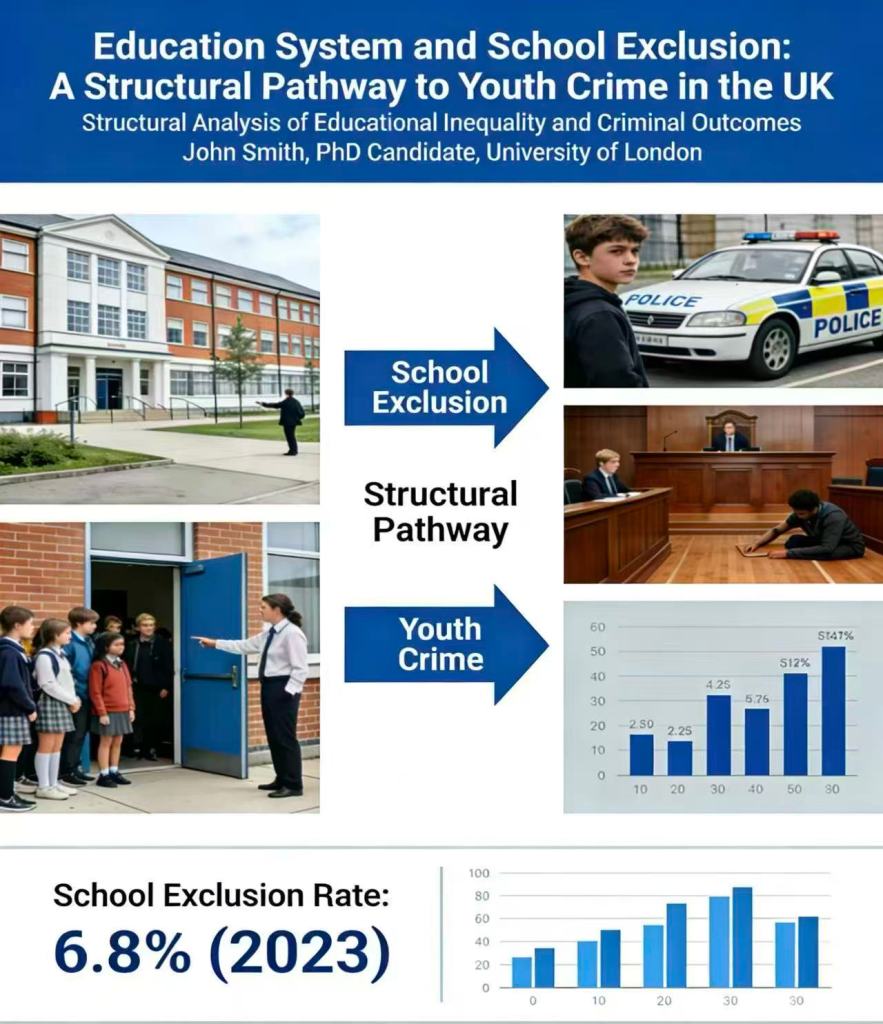
Youth crime in the UK is often explained through individual behaviour or family background. However, sociological and criminological research increasingly highlights the role of structural institutions, particularly the education system. One important issue is school exclusion, which includes both temporary suspensions and permanent expulsions from mainstream schools. While exclusion is intended to maintain discipline and protect the learning environment, evidence suggests it may also contribute to pathways into youth crime.
School Exclusion and Violent Offending
Empirical research shows a significant association between school exclusion and later violent offending. A recent longitudinal study published in the British Journal of Criminology analysed national education and justice records and compared over 20,000 matched pairs of excluded and non-excluded pupils. The study found that young people who were permanently excluded were about twice as likely to commit serious violent offences within 12 months compared with similar pupils who were not excluded (Cornish and Brennan, 2025).
These findings highlight the potential unintended consequences of exclusion. Schools often act as protective environments that provide structure, supervision, and access to support services. When students are excluded, they may lose these stabilising influences and spend more unsupervised time outside formal institutions. As a result, excluded pupils may become more vulnerable to risky environments, including involvement with gangs, violence, or criminal networks.
Evidence of Overlap Between Exclusion and Offending
Survey evidence also indicates a strong overlap between school exclusion and youth offending behaviour. Research conducted for the Youth Justice Board found that 72% of excluded pupils admitted committing an offence within the previous year, compared with far lower rates among students attending mainstream schools (Ipsos MORI, 2000). Although this does not prove that exclusion directly causes offending, it demonstrates a clear correlation between educational marginalisation and criminal behaviour.
Structural Inequality and Educational Disadvantage
Another important issue is that school exclusion disproportionately affects already disadvantaged groups. Studies have shown that excluded pupils are more likely to come from low-income families, experience social deprivation, or have special educational needs that are insufficiently supported within mainstream schools. As a result, exclusion may reinforce existing social inequalities rather than resolving behavioural difficulties.
From a criminological perspective, school exclusion can also contribute to processes of labelling and marginalisation. Once students are removed from mainstream education, they may internalise negative labels such as “problem pupil” or “troublemaker”. This can weaken their attachment to educational institutions and increase the likelihood that they become involved in deviant peer groups. Over time, these dynamics can contribute to what some scholars describe as a structural pathway from educational exclusion to criminalisation.
Limitations of a Simple Causal Explanation
However, it is important to acknowledge that exclusion itself is not necessarily the sole cause of youth crime. Many young people who are excluded have already experienced behavioural difficulties or challenging social circumstances prior to exclusion. Nevertheless, removing them from mainstream schooling may intensify their marginalisation and reduce access to protective support systems.
Conclusion
In this sense, school exclusion highlights how institutional practices can unintentionally reproduce structural inequality. Addressing youth crime therefore requires more than punitive responses within the criminal justice system. Instead, policymakers and educators increasingly emphasise preventative strategies, including early intervention, mental health support, and greater resources for students with additional educational needs. By focusing on inclusion rather than exclusion, education systems may play a critical role in reducing the long-term risks of youth crime.
Reference
Cornish, R.P. and Brennan, I. (2025) ‘Exclusion from school and risk of serious violence: A target trial emulation study’, The British Journal of Criminology, 65(6), pp. 1221–1240. Available at: https://doi.org/10.1093/bjc/azaf015.
Ipsos MORI (2000) New findings highlight link between school exclusion and offending. London: Youth Justice Board survey. Available at: https://www.ipsos.com/en-uk/new-findings-highlight-link-between-school-exclusion-and-offending.
 Site Title
留下评论